Padel vs Tennis: Which Racket Sport Should You Play?
Playing padel in the UK and tracking the sport's explosive growth.
Last Updated: March 2026
Free Download
Padel Quick-Start Guide
Rules, scoring, court etiquette, and what to bring — everything for your first session.
Plus the weekly newsletter. No spam, unsubscribe anytime.
Quick Summary
- Padel uses a smaller enclosed court (20m x 10m with glass walls) where walls are in play; tennis uses a larger open court (23.8m x 10.97m) with no walls
- Padel is easier to pick up — underarm serves, slower ball, and walls keep rallies alive; tennis has a steeper learning curve but a higher skill ceiling at elite level
- Padel is almost always doubles (4 players needed) and costs £7-£12 per person per session; tennis offers singles and doubles and costs £5-£15 per person
- Find courts near you — use the RacketRise Court Finder to find padel and pickleball courts across the UK
If you're weighing up padel vs tennis, you're not alone. With padel courts popping up across the UK at an extraordinary rate, thousands of tennis players — and people who've never picked up a racket — are asking whether padel is the better option. Maybe your local sports centre has just built padel courts. Maybe a mate keeps telling you to try it. Or maybe you're a tennis player who's seen those glass-walled courts on Instagram and wondered what all the fuss is about.
Quick Answer: If you want a social, accessible sport where you can rally from your first session and strategy matters more than power, choose padel. If you want more format variety (singles and doubles), a higher athletic ceiling, and 23,000+ UK courts, choose tennis. Both share the same scoring system, but they play very differently. Padel rewards placement, patience, and teamwork. Tennis rewards power, movement, and individual skill. Many players enjoy both.
Table of Contents
- Quick Side-by-Side Comparison
- How Are the Courts Different?
- How Is the Equipment Different?
- How Are the Rules Different?
- Scoring: What's the Same and What's Different?
- Physical Demands Compared
- Skill Transfer: From Tennis to Padel (and Back)
- How Much Does Each Sport Cost in the UK?
- UK Availability and Growth
- The Social Factor
- Learning Curve: Which Is Easier to Pick Up?
- Which Should You Choose?
- Can You Play Both?
- Sources & Further Reading
- Related Articles
- Frequently Asked Questions
Quick Side-by-Side Comparison
| Feature | Padel | Tennis |
|---|---|---|
| Court size | 20m x 10m (enclosed with glass walls) | 23.8m x 10.97m (open court) |
| Racket | Solid, no strings, foam core, perforated | Strung frame, longer handle |
| Ball | Lower pressure, slower bounce | Standard pressure |
| Serve | Underarm only | Overarm (can exceed 200km/h at pro level) |
| Walls | In play — ball rebounds off glass walls | No walls |
| Players | Almost always doubles (4 players) | Singles and doubles |
| Scoring | Tennis scoring (15, 30, 40) with golden point common | Tennis scoring (15, 30, 40) with advantage |
| Net height (centre) | 88cm | 91.4cm |
| UK players | 1,000,000 | 2.4 million |
| UK courts | 1,825 at 551 venues | ~23,000 courts |
| Cost per session | £7-£12 per person | £5-£15 per person |
| Starter equipment | £50-£100 (racket) | £30-£100 (racket) |
| Physical intensity | Moderate (lower-impact) | Moderate to high |
| Learning curve | Gentle — rallying within minutes | Steeper — consistent rallying takes weeks |
| Calories per hour | 400-600 | 400-700 |
That table gives you the overview. Now let's get into the details that actually matter when you're deciding which sport to commit to.
How Are the Courts Different?
The courts are the most visible difference between padel and tennis — and they fundamentally change how each game is played.
Padel Courts
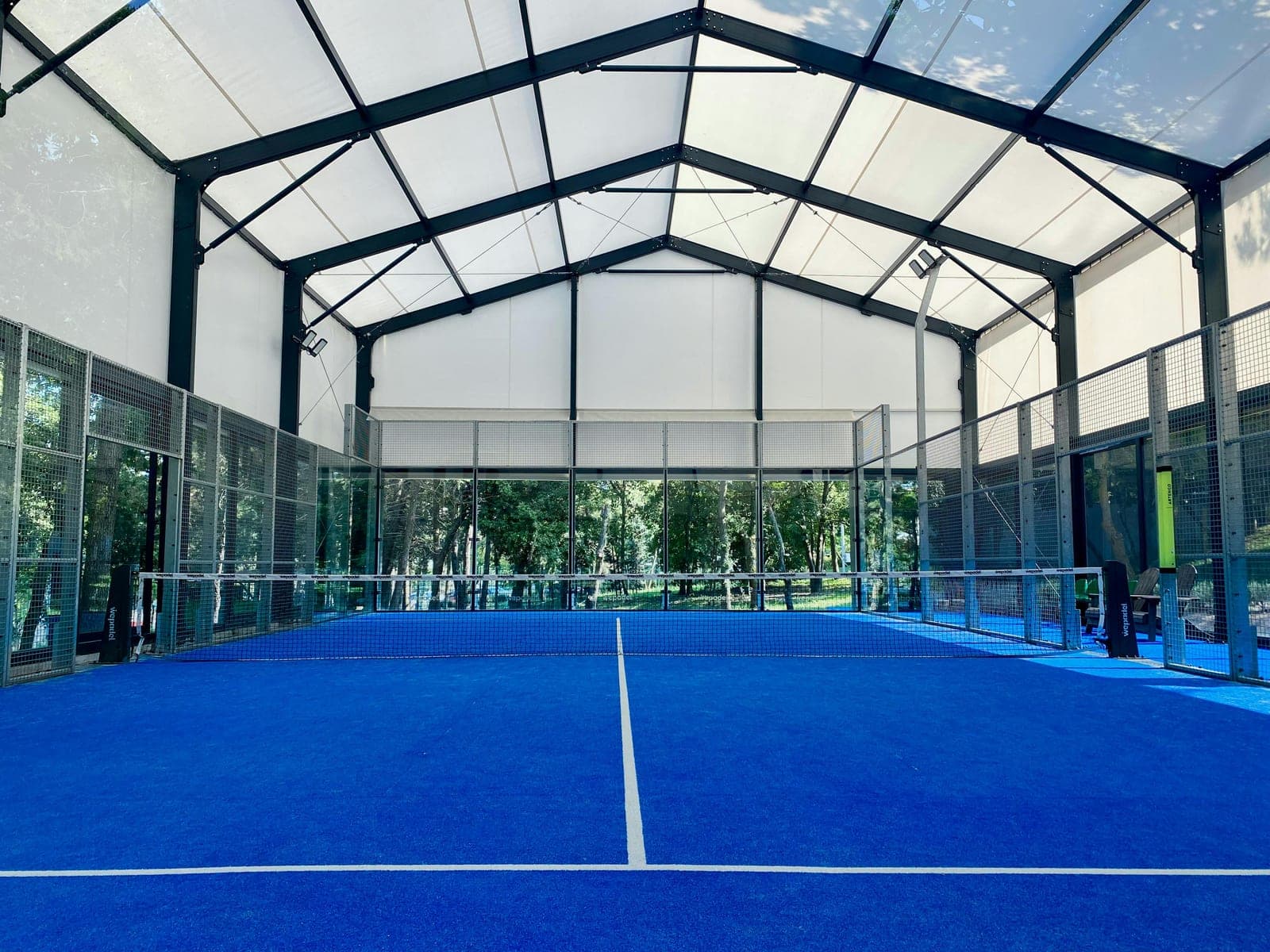
A padel court measures 20m x 10m and is completely enclosed. The back walls and parts of the side walls are made of tempered glass (typically 3-4 metres high), with metal mesh fencing above and along the rest of the sides. The total enclosure height is usually around 4 metres.
The crucial point: the walls are part of the game. After the ball bounces on your side, it can rebound off the glass — and you can still play it. This creates an entirely different dynamic to any open-court sport. Shots that would be clean winners in tennis become retrievable. Defence turns into attack. Rallies last longer and produce more dramatic points.
The net sits at 88cm in the centre and 92cm at the posts. The court has service boxes similar to tennis, divided by a central service line.
Because padel courts require glass walls, steel frames, and specialist construction, they cost £60,000-£120,000 per court to build. You can only play padel at purpose-built venues.
If you want the full breakdown of padel court features and rules, I've written a complete beginner's guide to padel that covers everything.
Tennis Courts
A tennis court measures 23.8m x 10.97m for doubles (8.23m wide for singles). It's an open court with no walls — the ball is out as soon as it passes the baseline or sideline without bouncing in play. The net height is 91.4cm at the centre and 107cm at the posts.
Tennis courts can be built on a variety of surfaces — grass, clay, hard court (acrylic), and artificial grass. Each surface changes the ball's speed and bounce behaviour, which adds a layer of tactical variety that padel doesn't have. A clay court rally plays very differently from a grass court rally.
Tennis courts are far cheaper and simpler to build than padel courts. A basic hard court costs £20,000-£40,000 and doesn't require enclosing structures. This is the main reason tennis has 23,000+ courts in the UK compared to padel's 1,000+.
| Court Feature | Padel | Tennis |
|---|---|---|
| Dimensions | 20m x 10m | 23.8m x 10.97m (doubles) |
| Surface area | 200 sq m | 261 sq m |
| Walls | Glass + metal mesh (in play) | None (ball is out beyond lines) |
| Net height (centre) | 88cm | 91.4cm |
| Surfaces | Artificial turf or concrete | Grass, clay, hard court, artificial |
| Build cost per court | £60,000-£120,000 | £20,000-£40,000 |
| Indoor options | Yes (most UK venues) | Yes (but fewer indoor courts) |
Key Takeaway: The enclosed padel court creates a completely different style of play. Balls stay in the game longer, rallies are extended, and spatial awareness includes the walls behind you. Tennis rewards court coverage and the ability to hit winners past your opponent. Padel rewards patience and the ability to construct points through wall play.
How Is the Equipment Different?
The equipment differences between padel and tennis are significant — and they directly affect how each sport feels to play.
Rackets
Padel rackets are solid with no strings. They have a foam core (usually EVA foam), a fibreglass or carbon fibre face, and are perforated with small holes across the hitting surface. They're shorter than tennis rackets (typically 45-46cm vs 68-71cm) and heavier relative to their size (350-385g). Padel rackets come in three shapes: round (control and forgiveness), teardrop (balanced), and diamond (power). Beginners should start with round or teardrop. For specific recommendations, check out the best padel rackets for beginners.
Tennis rackets have a strung frame — a head with strings (natural gut, synthetic, or polyester) stretched across it, attached to a longer handle. They weigh 260-340g (strung) and range from 68-71cm in length. The string bed creates much more power potential and spin generation than a solid padel racket face.
The practical difference: a padel racket is more forgiving. The solid face and shorter length make it easier to make contact with the ball. A tennis racket rewards good technique with more power and spin, but punishes poor technique more harshly — mishits are more common and more noticeable.
Balls
Padel balls look almost identical to tennis balls but have lower internal pressure. This means they bounce lower and slower, giving players more time to react. The reduced pressure also means the ball compresses more on impact, which suits the solid racket face.
Tennis balls have standard internal pressure (around 14 psi) and bounce higher and faster. The pressurised ball combined with a strung racket creates the explosive power that tennis is known for.
In practice, the lower-pressure padel ball is one of the main reasons padel is easier for beginners. Everything happens more slowly, which means more time to read the ball, move into position, and play your shot.
Shoes
Padel shoes need non-marking soles with good lateral support. Dedicated padel shoes from Asics, Head, and Adidas are available, but clean tennis shoes work perfectly well. The key movement in padel is side-to-side, so lateral stability matters most.
Tennis shoes are similar but often have more durable outsoles for harder court surfaces and greater cushioning for the impact of longer court coverage. Surface-specific shoes exist for clay, grass, and hard courts.
| Equipment | Padel | Tennis |
|---|---|---|
| Racket type | Solid, stringless, perforated, foam core | Strung frame |
| Racket length | 45-46cm | 68-71cm |
| Racket weight | 350-385g | 260-340g (strung) |
| Ball pressure | Low (depressurised) | Standard (~14 psi) |
| Ball speed | Slower | Faster |
| Shoes | Non-marking court shoes, lateral support | Surface-specific court shoes |
| Beginner racket cost | £50-£100 | £30-£100 |
Padel Tip: Don't buy a racket before you've played at least 3-4 times. Most venues offer racket hire for £3-£5 per session. Get a feel for the sport first, then choose your shape and weight based on experience — not Instagram ads.
How Are the Rules Different?
Padel and tennis share the same scoring system and some basic concepts, but the rules create two very different games.
Serving
Padel: The server bounces the ball and hits it underarm, at or below waist height. The serve goes diagonally into the opponent's service box. After bouncing in the box, the ball can hit the glass wall — but if it hits the metal mesh fence directly after bouncing, it's a fault. You get two serves, like tennis.
Tennis: The server throws the ball up and hits it overarm. The serve is often the most dominant shot in the game — professional serves regularly exceed 200km/h. The overarm serve allows for flat, slice, and kick variations that can be very difficult to return. You get two serves.
The underarm serve is one of padel's biggest accessibility advantages. In tennis, developing a reliable serve takes months of practice. In padel, you can serve competently on day one.
Wall Play: Padel's Defining Feature
This is the rule that changes everything. In padel, after the ball bounces on your side of the court, it can hit the back or side glass walls — and you can still play it. This means:
- Shots that would be winners in tennis are retrievable in padel
- Rallies last significantly longer
- Defensive play becomes a genuine art form
- Positioning includes awareness of the walls behind you
At professional level, players sometimes even run out of the court through the side door to retrieve a ball that has bounced over the back wall (a "bajada" or "salida"). You won't be doing that on day one, but the wall play is what makes padel addictive.
Tennis has no walls. The ball is dead once it passes the baseline or sideline without landing in play. This makes winners more common and rallies shorter on average.
Players and Format
Padel is played almost exclusively as doubles — four players, two per side. Singles padel exists on some modified courts but it's extremely rare in the UK. You need four people every time you want to play.
Tennis can be played as singles (one-on-one) or doubles. Singles is the more common format at club level and is the headline format in professional tennis. This flexibility is a genuine advantage — you only need one other person to play.
Volleys and Net Play
In both sports, volleying (hitting the ball before it bounces) is a key tactic. But the approach is different.
In padel, controlling the net is the primary attacking position. Teams try to move forward together to dominate the net, using volleys and smashes to put pressure on opponents. The defending team sits at the back, using the walls and lobs to push the attacking team away from the net.
In tennis, net play varies more by format and playing style. Some players are aggressive net-rushers, while others stay at the baseline. Singles tennis has seen a shift towards baseline play at the professional level, though doubles remains heavily focused on net control.
Scoring: What's the Same and What's Different?
Good news — if you know how to score in one sport, you essentially know the other.
Both padel and tennis use the same scoring system: 15, 30, 40, game. You play games within sets, and sets to 6 (with a tiebreak at 6-6). Matches are typically best of three sets.
The key difference is what happens at deuce (40-40):
Tennis (traditional): You need to win two consecutive points — "advantage" and then "game." This can extend games significantly. Some professional games have gone on for 20+ points at deuce.
Padel (commonly): Many social, league, and even professional padel matches use the golden point rule. At deuce, the receiving team chooses which side to receive on, and the next point wins the game. This keeps matches moving and adds a moment of high drama — one point to decide the game.
The golden point isn't universal in padel (some tournaments use traditional advantage scoring), but it's extremely common in UK club play and is the default on most booking platforms. It's one of those small differences that makes padel feel faster and more dynamic than traditional tennis scoring.
Did You Know? Golden point was introduced to padel to keep match times more predictable. A best-of-three padel match with golden point typically takes 60-90 minutes. A tennis match with advantage scoring can run significantly longer, especially on slower surfaces like clay.
Physical Demands Compared
Both sports provide excellent exercise, but the physical demands differ in important ways.
Padel: Lower Impact, Still a Proper Workout
A 60-minute padel session burns approximately 400-600 calories. The smaller court (200 sq m vs 261 sq m) means less ground to cover, but the longer rallies and wall play create sustained activity. You'll move laterally, sprint forward for volleys, backpedal to the glass, and change direction constantly.
The underarm serve is significantly easier on the shoulder than a tennis serve. Tennis players who develop shoulder problems — particularly rotator cuff injuries — from years of overhead serving often find padel a welcome alternative. The serve in padel generates virtually no injury risk.
Padel is lower-impact overall. Less running distance, no overhead serving stress, and the enclosed court means you spend less energy chasing down balls that go out of reach. But don't mistake "lower-impact" for "easy" — competitive padel will leave you properly tired, especially once rallies start extending with wall play.
Tennis: Higher Athletic Ceiling
A 60-minute tennis session burns approximately 400-700 calories, depending on format and intensity. Singles tennis is more physically demanding than doubles — you cover the entire court alone, which means significantly more running.
Tennis demands explosive sprinting, rapid changes of direction across a larger court, and the overhead serve puts considerable stress on the shoulder, elbow, and wrist over time. Professional tennis players cover 3-5km per match in singles. The physical ceiling is higher — but so is the injury risk.
Common tennis injuries — tennis elbow, shoulder impingement, stress fractures in the feet — are largely related to the repetitive high-impact nature of serving and covering a larger court. Padel players experience fewer of these issues due to the sport's lower-impact design.
| Fitness Factor | Padel | Tennis |
|---|---|---|
| Calories per hour | 400-600 | 400-700 |
| Cardio intensity | Moderate | Moderate to high |
| Impact on joints | Low to moderate | Moderate to high |
| Shoulder stress | Minimal (underarm serve) | High (overhead serve) |
| Court coverage | Moderate (smaller court) | High (larger court, especially singles) |
| Rally length | Longer (walls extend rallies) | Shorter (more outright winners) |
| Suitable for 50+? | Very suitable | Suitable with some adaptations |
| Common injuries | Wrist, knee (direction changes) | Shoulder, elbow, knee, ankle |
My take: I play both, and the physical difference is noticeable. After an hour of competitive padel, I'm tired but I could play again the next day. After an hour of competitive tennis singles, I need a recovery day. Padel gives you a workout that's sustainable — you can play three or four times a week without breaking down. Tennis is more demanding session-for-session, but that intensity can limit how often you play, especially as you get older.
Skill Transfer: From Tennis to Padel (and Back)
If you play tennis and you're thinking about trying padel — or vice versa — the good news is that many skills transfer between the sports.
What Tennis Skills Help in Padel
Volleys and net play. If you're comfortable at the net in tennis, you'll have an immediate advantage in padel. Volleying is the primary attacking weapon, and tennis players who can punch volleys and hit overhead smashes transition quickly.
Footwork and court awareness. Tennis footwork — split steps, lateral movement, recovery to a central position — applies directly to padel. You'll read the game faster than someone with no racket sport experience.
Understanding of spin and angles. Tennis players instinctively understand how spin affects the ball, which helps when reading rebounds off the glass walls in padel.
Scoring knowledge. The scoring system is identical. No learning curve there.
What Tennis Players Need to Unlearn
This is the critical part. Tennis players often struggle initially with padel — not because they lack skill, but because they bring habits that don't work.
Stop hitting hard. This is the single biggest adjustment. In tennis, power wins points. In padel, placement wins points. The walls mean that a hard shot off the back glass often sets up an easy return for your opponent. Padel rewards touch, angles, and patience — not brute force.
Learn to let the ball go past you. In tennis, you try to intercept every ball before it reaches the baseline. In padel, sometimes the best play is to let the ball bounce and come off the back glass, then play it after the rebound. This feels completely unnatural for a tennis player.
Adjust your serve. An overarm serve in padel is illegal. The underarm serve requires a completely different technique and mindset. Tennis players often feel awkward with the underarm action initially — it feels too passive. But a well-placed padel serve is just as tactical as a tennis serve, just in a different way.
Move with your partner. Tennis singles players are used to covering the court alone. In padel, you must move as a pair — up and back together. If one player is at the net and the other is at the back, you leave massive gaps. This team movement takes practice.
Tennis Player Tip: The biggest mental shift in padel is accepting that you don't need to hit winners. In padel, you construct points — move your opponents around, create a gap, and then finish it. Think chess, not boxing.
What Padel Skills Help in Tennis
If you start with padel and then try tennis, you'll bring strong net play, good hand-eye coordination, and tactical awareness. Your volleying will be solid. Your understanding of angles and court positioning will translate well to doubles tennis.
What you'll need to develop: the overhead serve (a completely new skill), longer-range groundstrokes, and the ability to cover a larger court on your own.
Free Download
Padel Quick-Start Guide
Rules, scoring, court etiquette, and what to bring — everything for your first session.
Plus the weekly newsletter. No spam, unsubscribe anytime.
How Much Does Each Sport Cost in the UK?
Cost is a real factor when choosing a sport, especially if you're planning to play regularly.
Padel Costs
| Item | Cost | Notes |
|---|---|---|
| Court hire (1 hour) | £28-£48 | Split 4 ways = £7-£12 per person |
| Off-peak court hire | £20-£32 | Weekday mornings, Sunday evenings |
| Racket hire | £3-£5 | Available at most venues |
| Group coaching | £10-£20 per person | 60-90 min group session |
| Your own racket | £50-£100 | Beginner range |
| Padel shoes | £40-£120 | Or use clean tennis shoes |
| First session cost | £7-£15 per person | Court + racket hire, split 4 ways |
Tennis Costs
| Item | Cost | Notes |
|---|---|---|
| Court hire (1 hour) | £5-£15 per person | Public courts; private clubs charge more |
| Club membership | £100-£600/year | Access to courts, social events, coaching |
| Group coaching | £8-£20 per person | 60 min group session |
| Your own racket | £30-£100 | Beginner range |
| Tennis shoes | £40-£100 | Surface-specific recommended |
| Balls | £4-£8 per tube | 3-4 balls per tube |
| First session cost | £5-£15 per person | Public court hire, borrow a racket |
The Real Cost Over a Year
Assuming you play twice a week for a year:
| Annual Cost | Padel | Tennis |
|---|---|---|
| Court fees (104 sessions) | £730-£1,250 | £520-£1,560 |
| Equipment (year 1) | £90-£220 | £70-£200 |
| Club membership | Not typically required | £100-£600 |
| Total year 1 | £820-£1,470 | £690-£2,360 |
The cost comparison is closer than most people think. Padel court hire is higher per session, but you always split it four ways. Tennis court hire is cheaper per hour at public courts, but club membership fees can push annual costs higher. Tennis also has a wider cost range — playing at a public park is cheap, playing at a private club is expensive.
Pro Tip: Both sports offer free or discounted taster sessions at most venues. Don't invest in equipment until you've played at least 3-4 times and know you want to continue. Hire everything for your first few sessions.
UK Availability and Growth
This is where the two sports differ most dramatically — and where the padel story gets genuinely exciting.
Tennis: The Established Giant
Tennis is deeply embedded in UK sporting culture. The LTA reports approximately 2.4 million active players across the country, supported by around 23,000 courts at thousands of venues — public parks, private clubs, schools, leisure centres, and sports centres.
You can find a tennis court almost anywhere in the UK. Most towns have at least one public court, and many have several. The infrastructure is mature, widespread, and well-maintained. Booking is generally straightforward, and availability is rarely a problem outside of prime-time summer slots.
Tennis participation in the UK is stable but hasn't seen the explosive growth of newer racket sports. The LTA has invested in grassroots programmes and facility improvement, and events like Wimbledon continue to drive seasonal interest. But the sport's year-on-year growth is modest compared to padel.
Padel: The Growth Story
Padel's UK growth has been extraordinary. The LTA reports participation tripling from 129,000 in 2023 to over 400,000 in 2024. Courts have grown from 68 in 2019 to over 1,000 by mid-2025, with 1,300+ projected by end of 2026. UK padel participation grew 125% through 2025, according to Playtomic data.
Major operators like Game4Padel, The Padel Club, and Pure Padel are building multi-court venues across the country. Powerleague is investing £14 million to build 76 padel courts across 17 locations. The LTA has invested over £6 million into padel development.
But padel's biggest challenge is court availability. With only 1,825 courts compared to tennis's 23,000, demand consistently outstrips supply. Peak-time courts in major cities sell out a week in advance. Coverage is concentrated in London (300+ courts), the South East, and major cities like Manchester, Leeds, Bristol, and Birmingham. Rural areas and smaller towns have limited options.
| UK Metric | Padel | Tennis |
|---|---|---|
| Active players | 1,000,000 | 2.4 million |
| Courts | 1,825 at 551 venues | ~23,000 courts |
| Year-on-year growth | 125% (2025) | Stable |
| Governing body | LTA (since 2019) | LTA |
| Court availability | Limited — book ahead | Generally available |
| Geographic spread | Major cities primarily | Nationwide |
| Investment | £6M+ from LTA, major private investment | Established infrastructure |
Looking for a court? Find padel courts across the UK with the RacketRise Court Finder.
The Social Factor
This is one of the underrated differences between padel and tennis — and for many people, it's the deciding factor.
Padel: Built for Socialising
Padel is always doubles. You need four people every time. This means padel is inherently social — you're constantly communicating with your partner, celebrating points together, and sharing the experience. The enclosed court adds to the intimacy. You're in a glass box with three other people, and the atmosphere is closer to a social event than a solo workout.
The padel community in the UK has embraced this social element. Over 90,000 "open matches" per month were played through Playtomic by the end of 2025 — that's strangers finding games together and meeting new people through the sport. Most venues run social sessions, leagues, and events designed to bring players together.
Many new padel players describe their first experience not in terms of the sport itself but the social atmosphere — the laughing, the high-fives, the post-match drink. Padel is one of those rare sports where the social element is as important as the competitive one.
Tennis: Flexible but Often Solo
Tennis offers more flexibility. You can play singles (just two people) or doubles (four people). This means you're never stuck if your group can't make four — you just play singles.
But that flexibility means tennis can also be a more solitary experience. Singles tennis is one-on-one with no partner to share the highs and lows. It can feel isolating, especially for beginners who struggle to keep rallies going. Tennis clubs build social communities through leagues, social events, and club nights, but the on-court experience itself is less inherently social than padel's mandatory doubles format.
If your primary motivation is meeting people and having a good time, padel has the edge. If you want the option to practise alone or play competitively one-on-one, tennis offers that flexibility.
Learning Curve: Which Is Easier to Pick Up?
This is one of the most common questions in the padel vs tennis debate, and the answer is clear.
Padel: Gentle Entry, Deep Mastery
Padel is easier to pick up. Here's why:
The underarm serve. You bounce the ball and hit it underarm. Almost everyone can do this competently on their first attempt. The tennis serve — toss, reach, swing, pronate — takes weeks or months to develop.
The walls keep rallies going. In tennis, a shot past the baseline is dead. In padel, the ball rebounds off the glass and comes back into play. This means beginners spend more time rallying and less time picking up balls. More rallying means more fun, faster improvement, and better exercise.
The slower ball. The lower-pressure padel ball moves more slowly, giving players more time to react, move into position, and play their shot.
The smaller court. Less ground to cover means less running and easier court coverage. You don't need elite fitness to keep up.
Most complete beginners can hold rallies within their first 5-10 minutes on a padel court. You can play a competitive game on your first day. The wall play — which is what gives padel its depth — takes longer to master. Most players become comfortable with basic wall play after 2-3 months of regular play. Advanced wall play, including offensive use of the glass and reading complex rebound angles, develops over years.
Tennis: Steeper Start, Higher Ceiling
Tennis is harder to pick up. The overhead serve alone takes significant practice. Consistent groundstrokes require good technique — grip, stance, swing path, timing. Complete beginners often spend their first several sessions struggling to keep rallies going, which can be frustrating.
But the skill ceiling is arguably higher. At elite level, tennis offers extraordinary variety — flat shots, topspin, slice, drop shots, serve-and-volley, baseline grinding, and the ability to change the entire character of a match by switching tactics. The combination of an open court, a strung racket, and a full-pressure ball creates more shot-making potential than padel's enclosed, wall-assisted format.
For most recreational players, though, the learning curve matters more than the theoretical skill ceiling. And on that front, padel wins clearly.
| Learning Factor | Padel | Tennis |
|---|---|---|
| Time to first rally | 5-10 minutes | Several sessions |
| Time to play a full game | First session | 2-4 weeks |
| Time to feel "competent" | 2-3 months | 3-6 months |
| Hardest thing to learn | Wall play and positioning | Serve and consistent groundstrokes |
| Tennis experience helpful? | Yes — volleys, footwork, scoring | N/A |
| No racket sport experience? | Still very accessible | Steeper learning curve |
| Skill ceiling (elite level) | High — tactical depth, wall mastery | Very high — shot variety, physical demands |
Which Should You Choose?
After covering all the differences, here's a practical framework for deciding.
Choose Padel If You...
- Want a sport that's easy to pick up and fun from day one
- Love the idea of a social, team-oriented game (always doubles)
- Have 3 friends who want to play regularly
- Want a lower-impact sport that's sustainable long-term
- Have shoulder issues or find the tennis serve painful
- Enjoy tactical, strategic play over raw power
- Are attracted to the wall play and the unique angles it creates
- Don't mind that court availability can be limited
Choose Tennis If You...
- Want the option to play singles (just need one other person)
- Enjoy a more physically intense, athletic challenge
- Want access to 23,000+ courts across the UK with easy availability
- Like the variety of surfaces (grass, clay, hard court)
- Want a sport with a deep competitive structure from club to professional level
- Are drawn to the serve-and-volley, power game
- Prefer a sport with more established infrastructure and coaching pathways
- Want to play at public parks for minimal cost
The Decision Comes Down to Personality
Here's what I've observed covering racket sports: the padel vs tennis choice often comes down to personality more than anything else.
If you're competitive and social — padel. The doubles format means you win and lose together. The wall play extends rallies and creates more drama. Points are earned through patience and teamwork.
If you're competitive and independent — tennis. Singles tennis is one of the purest competitive formats in sport. It's just you against one opponent. Every point is won or lost on your own merits.
If you're social and casual — padel, without question. The atmosphere on a padel court — even during competitive matches — is lighter and more fun than tennis. The enclosed space, the teamwork, the celebration of good wall play: it all adds up to a brilliant social experience.
If you want maximum exercise — tennis singles delivers a more intense workout. But padel is close behind and is more sustainable for regular play.
Can You Play Both?
Absolutely. And many people do.
The skills transfer well in both directions. Tennis players bring strong net play, good footwork, and an understanding of angles to padel. Padel players bring tactical awareness, volleying skills, and hand-eye coordination to tennis.
The biggest trap is treating them as the same sport. They're not. Padel requires you to dial down the power and dial up the patience. Tennis requires you to cover more ground and generate your own pace. If you can make that mental switch when you step onto each court, both sports will benefit.
Playing both also gives you variety. Padel for the days you want a social, team experience. Tennis for the days you want an individual challenge or a more intense physical workout. They complement each other rather than compete.
I've spoken to dozens of players who play both sports in a typical week. The consensus is clear: playing padel makes you a better volleyer in tennis, and playing tennis gives you more power options in padel. The crossover is genuinely beneficial.
Try Both: Most padel venues offer taster sessions for £10-£15 per person. Tennis courts at public parks are available from as little as £5. There's no reason not to give both sports a fair trial before deciding which deserves more of your time.
Sources & Further Reading
- LTA Padel — Over 400,000 players — Official padel participation statistics for Great Britain
- LTA Padel — 1,000 courts milestone — UK padel court growth from 68 in 2019 to 1,000+ in 2025
- Playtomic UK participation data 2025 — 125% growth in UK Playtomic users through 2025
- LTA — Tennis participation data — Official UK tennis player numbers and court statistics
- The Padel Directory — UK market guide — Market size, awareness stats, and industry forecasts
Frequently Asked Questions
Is padel easier than tennis?
Yes, padel is easier to pick up. The underarm serve removes the most difficult skill in tennis, the enclosed court keeps rallies going longer (so you spend more time playing and less time fetching balls), and the lower-pressure ball moves more slowly. Most beginners can rally within 5-10 minutes of stepping onto a padel court. Tennis typically takes several sessions before beginners can maintain consistent rallies.
Is padel replacing tennis in the UK?
No — padel is growing alongside tennis, not replacing it. Tennis has 2.4 million active players and 23,000+ courts in the UK, with deep roots in the country's sporting culture. Padel has 1,000,000 players and 1,825 courts, growing rapidly but from a much smaller base. Many padel players also play tennis. The two sports complement each other, and the LTA governs both.
Can tennis players play padel?
Absolutely — and many do. Tennis skills like volleying, footwork, and understanding spin transfer well to padel. The main adjustments are learning to use the walls, switching to an underarm serve, and reducing power in favour of placement. Most tennis players who try padel find it immediately enjoyable, though mastering the wall play takes time.
Is padel a better workout than tennis?
It depends on format and intensity. Tennis singles burns slightly more calories per hour (400-700 vs padel's 400-600) because you cover a larger court alone. But padel produces longer rallies and more sustained movement. Padel is lower-impact overall — the underarm serve reduces shoulder stress, and the smaller court means less running. For a sustainable, regular workout, padel is excellent. For maximum calorie burn in a single session, tennis singles has the edge.
Why is padel growing so fast?
Several factors: it's easy to learn (underarm serve, walls keep rallies going), inherently social (always doubles), accessible to all fitness levels, and well-supported by LTA investment. The sport also benefits from strong word-of-mouth — players who try padel tend to tell their friends, who then try it themselves. UK awareness of padel reached 43% among adults in early 2025, up from 23% twelve months earlier.
Is padel or tennis cheaper?
The costs are similar overall. Padel court hire (£28-£48/hour split four ways) works out to £7-£12 per person. Tennis public court hire is £5-£15 per person. However, tennis club memberships (£100-£600/year) can push annual costs higher. Equipment costs are comparable — £50-£100 for a beginner racket in either sport. For pure session-by-session cost, tennis at public courts is marginally cheaper; for all-in annual costs, padel and tennis are in a similar range.
Can you play padel singles?
Technically yes, but it's rare. Some UK venues offer singles padel on modified courts, but the sport is designed for doubles. The court dimensions, wall play, and rules are all optimised for four players. If you want a singles racket sport, tennis is the better choice. If you enjoy the doubles format and team play, padel is outstanding.
What's the biggest difference between padel and tennis?
The walls. In padel, the glass walls around the court are in play — after the ball bounces on your side, it can rebound off the walls and you can still return it. This single rule changes everything about how the game is played. Rallies are longer, defence is more viable, and power is less important than placement. In tennis, the ball is out once it passes the baseline, which means winners are more common and points are generally shorter.
Disclaimer: This article is for informational purposes only. Equipment recommendations are based on research and testing — individual preferences may vary. Always consult venue staff about court-specific requirements. Prices and availability are subject to change.
Free Download
Padel Quick-Start Guide
Rules, scoring, court etiquette, and what to bring — everything for your first session.
Plus the weekly newsletter. No spam, unsubscribe anytime.
Tools & Quizzes
Ready to play? Find a padel court near you — 1,600+ UK venues with booking links.
Unfamiliar term? Look it up in the Padel Glossary.